 Crewcial Partners
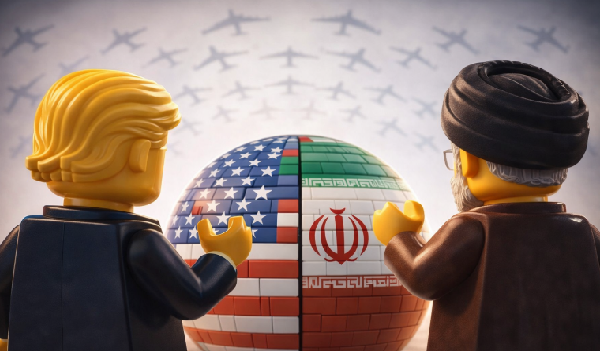
On March 1, 2026, Iranian Shahed drones directly struck two Amazon Web Services data centers in the UAE and damaged a third in Bahrain. AWS confirmed structural damage, disrupted power delivery, fire suppression activity, and water damage across the three facilities. Banking services, payments platforms, and consumer applications across the Gulf went offline. Iran subsequently named 18 US technology companies as legitimate targets, including Amazon, Google, Microsoft, Oracle, Nvidia, and others, citing their role in supporting US military and intelligence operations. Iran also claimed a strike on an Oracle data center in Dubai on April 2, a claim Oracle has not confirmed. As of this writing, dozens of Amazon Web Services (AWS) services in Bahrain and the UAE remain unavailable. The March 1 strikes mark the first confirmed military attack on hyperscale cloud infrastructure in history, and with tensions escalating, they are unlikely to be the last.
However, the market's response is the more instructive data point. Amazon's stock dropped sharply when trading opened on March 3, then rallied approximately 3% over the following days, essentially registering the event as material, then concluding it was absorbable. Whether that conclusion reflects genuine analysis of the long-term operating environment or a shorter-term judgment about near-term earnings impact is the question the rally does not answer. Hyperscalers can write off individual facilities against capital budgets now estimated at $600-750 billion annually, but a more crucial focus is the question of what such a precedent costs, and that bill has not been presented yet.
The logic of the attack is worth examining carefully, because it is the logic that will govern future attacks. Iran identified Western technology infrastructure not as a military target in the conventional sense, but as a symbol of economic power and a node of operational dependency. Striking a data center does not require the precision, cost, or risk of engaging a military asset. A Shahed-136 loitering munition costs as little as $20,000. The AWS facilities it damaged represent billions in capital investment and underpin commercial infrastructure across an entire region. That asymmetry between the cost of the weapon and the cost of the target is what makes this threat class structurally different from anything the risk models governing these investments were built to price.
The technical conundrum compounds a strategic one. AWS's multi-availability-zone architecture is designed to absorb single-zone outages seamlessly. Two UAE zones were struck simultaneously and local authorities cut power to the surrounding area, taking the backup systems offline. Standard redundancy models, built for equipment failures and localized outages, were not designed for coordinated kinetic strikes in an active war zone. In a sense, the system didn't fail, the assumptions did.
For institutional investors, the exposure runs well beyond the direct damage. Regional courts are likely to view operating in a conflict zone as a foreseeable risk, meaning cloud providers, not clients, may be required to absorb upstream costs and refund affected customers entirely. Enterprise clients with sovereign data residency requirements face a harder problem: they cannot simply migrate workloads to alternate regions when their regulatory obligations tie them to the geography. The UAE's data-center market was projected by analysts to more than double in value by the early 2030s; that forecast was made before the strikes. The question now is not whether the market recalibrates, but how long it takes to acknowledge that a recalibration is necessary.
Compounding the operational risk is an environment that offers no stable resolution. A two-week ceasefire brokered by Pakistan took effect on April 8; it came under immediate strain from Israeli strikes in Lebanon, the talks in Islamabad collapsed on April 12, and as of April 13 the United States has imposed a naval blockade of Iranian ports, with oil above $100 a barrel (with much of the saga played out via presidential Truth Social posts and retaliatory X responses). It is certainly not the settlement of a war symptomatic of a broader and deeply rooted ideological conflict. In other words, whatever follows will not be linear, but likely a fragile peace navigating deeply unresolved forces, with peaks and valleys as unpredictable as the current conflict itself.
Iran's conventional military capacity has been degraded, but a state that has lost its supreme leader, seen its deterrence infrastructure dismantled, and watched its proxy network fragment is not a more predictable adversary. Iran's identification of US technology companies as legitimate targets did not expire with the ceasefire. Meanwhile, China has been moving deliberately into the space, which widens in each instance of its rivals' strategic incoherence. Gulf sovereign wealth funds accounted for over 60% of China's sovereign inflows in 2024 and Chinese firms maintain a growing infrastructure presence in the same areas where Western hyperscalers are now managing active conflict risk. The calculus for Gulf sovereigns (e.g., who to partner with, whose infrastructure to host, whose security umbrella to rely on) is by no means settled.
For those managing long-duration capital, the discipline required here is the same that governs every uncomfortable conversation about a portfolio holding that has gone from attractively valued to uncomfortably exposed. The instinct to wait for clarity or normalcy to reassert itself is the risk. The companies whose valuations embed Gulf growth assumptions have not repriced those assumptions. The security frameworks that were meant to protect the investments focused on supply chain control and geopolitical alignment, not physical defense during high-intensity conflict. Less an oversight, this was a collective understanding held implicitly by boards, investment committees, and analysts alike.
The lights went out across parts of the Gulf in March 2026. In some instances, they came back on. What has not, or should not, come back is the assumption that this geography is a stable foundation for infrastructure that will need to operate predictably for a decade or more. Whatever the case, the precedent has been set. Markets have absorbed the strike and moved on. The question for long-duration investors is whether that response reflects genuine analysis or the same instinct to avoid an uncomfortable conversation that made the infrastructure bet feel safer than it was in the first place.
All investment-related observations reflect Crewcial Partners' analytical perspective and do not constitute investment advice.