QUARTERLY HIGHLIGHTS


US


The US economy entered 2026 in a more stable but still uncertain position. Temporary disruptions from the government shutdown faded, though broader macro crosscurrents persisted. GDP data suggested moderate growth, but early indicators point to an economy holding course rather than accelerating. Consumer spending held steady, though signs of fatigue have begun to emerge as households navigate elevated living costs and reduced excess savings.
 
The economy continues to be shaped by structural strength and emerging constraints. The AI infrastructure investment cycle remains a meaningful tailwind, supporting business fixed investment, though this is increasingly offset by tighter financial conditions, slower credit formation, and a more cautious consumer, particularly among lower-income cohorts. Conflict with Iran and uncertainty over Strait of Hormuz energy flows have led to higher and more volatile oil prices, adding pressure to input costs and complicating the inflation outlook.
 
The Federal Open Market Committee (FOMC) met in January and March, holding the federal funds target range at 3.50-3.75% at each meeting; neither decision was unanimous. At the March meeting, the Federal Reserve (the Fed) acknowledged that geopolitical uncertainty posed an equal chance of unmooring inflation expectations or destroying demand. The Fed's balance sheet remained stable at $6.7 trillion. Federal funds futures imply a 3.6% rate by year-end 2026, approximately 20 basis points above the Fed's own projection.
 
Private-debt markets in the first quarter exhibited structural friction driven more by fund flows and liquidity management than by broad asset deterioration. Redemption activity reached a visible inflection point across semi-liquid private credit vehicles, prompting several large managers, including Blackstone, Blue Owl Capital, Apollo Global Management, and Ares Management, to deploy gates and other liquidity tools. This increased scrutiny around fund structures, NAV integrity, and the gap between retail redemption expectations and institutional asset durations, particularly as retail participation in the asset class continues to expand.
 
Credit-quality trends remained broadly stable, though pockets of pressure emerged within software exposures underwritten at peak multiples, where moderating growth, higher financing costs, and AI disruption have begun to raise questions of debt service capacity. Managers have generally favored amend-and-extend strategies or PIK (Payment-in-Kind) features over realizing immediate losses or triggering formal defaults. Idiosyncratic write-downs were observed but remained contained, marking a transition toward a more credit-selective environment where liquidity optics and sector-specific underwriting are the primary drivers of manager dispersion.

row-spacer
row-spacer
 
 
EUROPE


The euro area entered 2026 with modest but positive momentum, though the impact of war and higher oil prices was largely yet to be felt, with GDP data indicating approximately 0.2% quarter-on-quarter Q4 2025 growth. Growth remained uneven across the region, with Spain and smaller peripheral economies continuing to outperform, supported by strong services activity and tourism, while France, Germany, and Italy lagged, weighed down by weak industrial production and subdued external demand. Real income gains and a resilient labor market supported consumption, though household spending remained cautious overall. Investment activity was also positive, providing some offset to softer exports.

Early 2026 data pointed to a fragile but positive environment. The HCOB Eurozone Composite and Manufacturing PMIs both remained below or near 50, reflecting continued contraction in industrial output and export orders with only marginal overall expansion. The Services PMI remained in expansion territory, supported by domestic consumption and travel-related demand. Inflation dynamics were somewhat uneven: headline inflation reaccelerated to around 2.4-2.5% in March from approximately 1.9% in February, driven in part by higher oil prices, while core inflation continued to trend downward towards the European Central Bank’s (ECB) 2% target.

Against this backdrop, the ECB maintained a cautious, data-dependent stance, holding the deposit facility rate steady at 2% following earlier cuts in 2025. President Lagarde emphasized that while inflation has moved closer to target, it remains too early to declare victory, citing ongoing risks from global trade tensions and geopolitical uncertainty. Fiscal and industrial policy became more supportive, with Germany and France both advancing defense and strategic investment spending, while the European Commission implemented programs prioritizing AI, semiconductors, and cloud infrastructure across the region.

 
CHINA


China's economy exhibited notable resilience at the start of 2026, with quarter-on-quarter GDP growth of 1.3% and year-over-year growth of 5.3%, driven primarily by industrial production and ongoing infrastructure investment. Manufacturing activity, particularly in EVs, batteries, and semiconductors, was a bright spot. However, domestic demand remained uneven, with household consumption constrained by weak confidence and the lingering effects of the property downturn. Real-estate investment continued to contract, though at a more gradual pace, suggesting early signs of stabilization.

More granular data pointed to a mixed but positive environment. Manufacturing activity hovered near the expansion threshold, supported by resilient export demand and industrial policy tailwinds, while services PMIs were in expansion territory but softened. Exports remained relatively firm, benefiting from front-loaded demand and competitiveness in key sectors, while imports remained subdued, underscoring weak domestic demand. The external backdrop grew more challenging as geopolitical tensions and ongoing conflict contributed to higher and more volatile oil prices, raising input costs for Chinese manufacturers.

The People’s Bank of China (PBOC) left benchmark rates unchanged, while fiscal policy continued to emphasize infrastructure and strategic industries as part of a broader push for technological self-sufficiency. Beijing's March release of its 15th Five-Year Plan (2026-2030) prioritizes technology-led growth, industrial upgrading, and supply chain resilience, positioning AI and advanced manufacturing as central pillars of long-term economic strategy. Authorities also maintained targeted support for the property sector aimed at stabilizing housing demand and developer liquidity.

 
JAPAN


Japan's economy started the year on better footing than previous forecasts, with the Cabinet Office's revised Q4 2025 GDP release showing real output rising quarter-on-quarter 0.3%, or 1.3% annualized. Business capital expenditures were a key contributor, rising 1.3% in the fourth quarter, a sharp revision from the preliminary estimate of 0.2%. Private consumption, which accounts for more than half of Japan's economy, was also revised higher to 0.3%. Net trade made no contribution to growth, as both exports and imports declined modestly, reflecting softer external demand and the lingering drag from prior US tariff pressures.

Prime Minister Sanae Takaichi secured a landslide victory in Japan's February general election. Her platform emphasizes increased defense spending and targeted fiscal expansion, including investment in semiconductors and AI. Business sentiment also improved through the quarter, with the Bank of Japan (BOJ) Tankan Survey showing modest gains in confidence among large manufacturers and continued strength among non-manufacturers, supported by resilient services demand and inbound tourism.

The BOJ held its benchmark rate steady at 0.75% at its January and March meetings. Following the March meeting, Governor Ueda reiterated that further tightening would depend on the durability of wage-driven inflation rather than transitory cost pressures, signaling a wait-and-see approach to current geopolitical uncertainty, though he noted that more board members are now focused on upside price risks than downward pressure. The government continued targeted fiscal support measures, including energy subsidies, to help offset the impact of higher living costs.

 
COMMODITIES


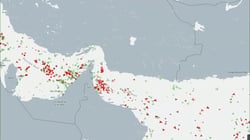
The S&P GSCI ended Q1 2026 with a total return of 42.82%. Energy (+86.42%) and precious metals (+9.18%) were the best-performing constituents; agriculture (+6.64%) was the smallest contributor. Within energy, the quarter was defined by disruption to Middle Eastern production and shipping as conflict effectively closed the Strait of Hormuz, cutting off approximately 20% of global oil supply as well as natural gas and fertilizer flows. Qatar's Ras Laffan liquefied natural gas (LNG) facility sustained damage, though Saudi Arabia diverted some oil supply via its East-West pipeline. Precious metals posted positive returns for the period but saw sharp declines in March, as profit-taking following a strong prior run for gold and silver combined with expectations of higher interest rates weighed on both metals. Industrial metals, livestock, and agriculture registered smaller positive returns,

Digital assets began Q1 2026 with consecutive drawdowns in January and February, followed by a partial recovery in March, supported by a joint Securities and Exchange Commission (SEC) and Commodity Futures Trading Commission (CFTC) interpretation classifying 16 digital assets as commodities under CFTC jurisdiction. The quarter reflected two competing narratives: regulatory infrastructure supporting long-term institutional adoption has never been more developed, yet near-term price action continued to reflect macro-driven, risk-off sentiment.

US:
thecontrol-columnchart-gms-equity-market-performance
The recession forecasted by economists in late 2022 failed to materialize in 2023, as the US economy, carried by a resilient consumer sector, overcame a remarkable number of macroeconomic headwinds.  The US ended the year in the remarkable position of having sustained economic growth, downward trends in inflation, higher interest rates, and steady unemployment. Buoyed by expectations that interest-rate cuts may be imminent, markets ended the year just short of the record highs set in early 2022.  Meanwhile, optimism over economic factors and labor supported gains in consumer confidence across all groups.  Forward-looking measures of business activity were more middling, with the ISM Services Purchasing Managers' Index (PMI) remaining in expansionary territory but down from earlier in the year, and manufacturing PMIs still in contractionary territory but showing signs of improvement with an uptick in production and employment. Following a difficult internal struggle to elect a new speaker of the house, the US House of Representatives passed another short-term spending bill averting a government shutdown; this was quickly approved by the Senate and signed into law. The stopgap spending bill extends funding for military construction, veterans’ benefits, transportation, housing, urban development, agriculture, the Food and Drug Administration, and energy and water programs through January 19, while remaining silent on contentious spending cuts and border-security measures sought by some Republicans.
 
 thecontrol-columnchart-gms-credit-market-performance
The Federal Open Market Committee (FOMC) met in November and December.  At both meetings, it agreed to maintain the federal-funds target rate corridor at 5.25-5.50%.  At the December meeting, the Summary of Economic Projections (SEP) was updated: the most noteworthy change was that Federal Reserve (Fed) officials decreased the median projection for the federal-funds target rate at the end of 2024 from 5.1% to 4.6%.  The FOMC made no changes to its balance-sheet reduction plans ($95 billion per month), but the minutes of the December meeting indicated that the FOMC is soon likely to “begin to discuss the technical factors that would guide a decision to slow the pace of (balance-sheet) runoff”; the Fed’s balance sheet fell from $8.1 trillion to $7.8 trillion to close out 2023.
 
Among the sectors of the economy most sensitive to rates, the spotlight remains on commercial real estate, as higher interest rates continue to present challenges for commercial real-estate debt reaching maturity.  Across all sectors, data-provider Trepp estimates that a total of $550 billion of commercial real-estate loans will come due in 2024, followed by $530 billion in 2025.  The extent to which lenders will continue to work with borrowers remains in focus, as borrowers faced with rolling debt face higher debt-service costs upon refinancing.  The office sector continues to draw attention, as office delinquencies remain in the headlines.  According to Trepp, the CMBS office delinquency rate surged from 1.58% in December 2022 to 5.82% in December 2023.  Refinancing office properties continues to prove markedly challenging as lenders continue to exercise caution in this sector. 
 
Meanwhile, the residential housing market has maintained its strength despite higher interest rates.  Driven by a scarcity of inventory, the S&P CoreLogic Case-Shiller Housing Price Index achieved a record high in October 2023.  In December 2023, Fannie Mae’s Home Purchase Sentiment Index reached its highest level since April 2022, driven by softening interest-rate expectations.
 
EUROPE:

According to data from Eurostat, economic growth across the Eurozone declined (-0.1% quarter over quarter) in the third quarter, as the region faced headwinds from inflation, rising interest rates, and tightened fiscal policies.  Among the larger economies, France, Spain, and Belgium experienced growth while Germany contracted from persistent inflation, high energy prices, and weak foreign demand.  Forward-looking economic indicators weakened for the region; the HCOB's final Composite PMI came in at 47.0.  Manufacturing activity continued to contract and demand for services declined as consumers pulled back on spending.  However, there was some signs of improvement in the manufacturing sub-indices tied to new orders and purchasing activity.  Additionally, Eurozone unemployment remained at a record low of 6.4%; employment increased in both services and construction, offsetting weakness in the manufacturing sector. Overall, job vacancy rates have come down from their peaks but remain relatively high by historical standards.

After declining for much of the past year, the rate of inflation across the Eurozone rose to 2.9% in December. The uptick in inflation was primarily due to technical factors, as the impact of base effects and the timing of government subsidies overwhelmed slower price growth for other goods. (Note, core inflation, which doesn’t include energy, food, alcohol, and tobacco prices, ended the year at 3.4%, down from its 2022 peak.) In its last meeting of the year, the European Central Bank (ECB) reaffirmed its benchmark interest-rate policy and announced plans to phase out the last of its COVID-19 era bond-buying programs. The ECB also changed its language around inflation—from describing it as “expected to remain too high for too long,” to saying that it will “decline gradually over the course of next year.”  In her statements following the meeting, ECB President Christine Lagarde assumed a more measured tone and argued against calls for imminent cuts to interest rates, stating that it’s too early to “lower our guard” and that the bank is “data dependent, not time dependent.”

 
CHINA:

China’s economic data in Q4 2023 presented a mixed picture.  Industrial output experienced a significant rebound, growing by 4.6% (year on year) in October and an impressive 6.6% in November.  This growth—the fastest pace since February 2022—underscored the sector’s recovery and contribution to the economy.  On the other hand, already affected by a downturn in the property sector, reduced land sale revenue, and a slowdown in export manufacturing, consumer spending was further impacted by household deleveraging.  Credit cards and mortgage loans saw a decline, indicating caution among consumers.  Overall spending remained below pre-COVID levels, suggesting a slow and gradual path towards recovery.

In response to the property market's challenges, the Chinese government rolled out several initiatives, including reducing down-payment thresholds and mortgage interest rates, and easing restrictions on second-home purchases.  Such measures were designed to ease financial pressure on homebuyers and stimulate market activity.  Another notable development was the provision of low-cost financing, amounting to CN¥1 trillion, for urban village renovations and affordable housing projects.  This significant investment is intended to support the real-estate sector, a critical component of China's economy.  Early indications suggest a positive reception from homebuyers, particularly in major cities, signaling a potential upturn in the real-estate market.

The November 2023 meeting between Chinese President Xi Jinping and US President Joe Biden was a landmark event.  Key topics included curbing illicit fentanyl production and military cooperation, alongside a dialogue on artificial intelligence emphasizing the importance of managing risks and safety issues.  Described as ‘constructive and productive,’ the meeting underlined both leaders' desire for peaceful coexistence and the necessity of avoiding miscommunication.  While it did not resolve all critical geopolitical issues, the meeting was viewed as a positive step towards stabilizing US-China relations.  The meeting's conciliatory tone and focus on cooperation in specific areas signaled a potential easing of the strained relations between the two nations.


JAPAN:

Japan’s economy contracted at an annualized growth rate of 2.9% in the third quarter, as a decline in private consumption, which makes up more than half the economy, weighed on economic growth. Although nominal salaries rose year over year, higher prices and inflation wiped out the wage growth in real terms, negatively impacting consumers' purchasing power. In November, Prime Minister Fumio Kishida’s administration announced a new economic stimulus package (approximately $113 billion), aimed at helping households with rising costs. The packages included cuts to income and residential taxes, direct benefits to low earners, extended fuel and electricity subsidies, and funds to support the semiconductor sector.

Japanese business sentiment continued to improve during the quarter as measured by the Tankan survey.  Results were especially strong among large manufactures; automakers' moods brightened as the industry benefited from a weak yen and an easing of supply constraints.  Non-manufacturing sentiment was positive as well, improving for the seventh straight quarter; recovering inbound tourism gave a significant boost to non-manufacturers.  Year to date through November, foreign visitors to Japan topped 20 million for the first time since 2019.

December data showed consumer core inflation trending downwards.  Energy and fuel prices declined due to a combination of government subsidies and base effects.  However, services inflation persists, driven primarily by demand for accommodations and food.  The Bank of Japan (BOJ) ended the year with its low-interest polices in place.  In his statement following the BOJ’s December meeting, Governor Kazuo Ueda cooled speculation about future rate hikes, stressing that more data is needed to confirm a positive wage-inflation cycle and the uncertainty surrounding inflation’s sustainability.


COMMODITIES:

The S&P Goldman Sachs Commodity Index (SPGSCI) ended the quarter down with a total return of 10.73%, driven mainly by price gains for industrial metals and precious metals failing to offset weaker prices for energy, agriculture, and livestock.  Contrary to Q3 2023, energy (16.74%; S&P GSCI Energy—SPGSEN) underperformed all other SPGSCI sub-index constituents, with sharply lower prices for crude oil, natural gas, and gas oil.  These detractors to performance occurred despite output cuts from OPEC+. Agriculture (0.73%; S&P GSCI Agriculture—SPGSAG) ended the quarter with higher prices for soybeans, coffee, wheat, and cocoa failing to offset considerable price declines for sugar, corn, cotton, and Kansas wheat.  The precious metals segment outperformed all other commodity constituents during the quarter (10.99%; S&P GSCI Precious Metals—SPGSPM), as both gold and silver achieved robust price gains during Q4 2023.  The industrial metals segment realized a modest gain during the quarter (0.82%; S&P GSCI Industrial Metals—SPGSIM), as prices for aluminum, copper, and zinc offset weaker prices for nickel and lead.   

Following a relatively quiet period in Q2/Q3 2023, the digital-assets market performed well during Q4.  The premier digital token, Bitcoin, was up 57% in Q4 2023, while the second most-popular digital token, Ethereum (ETH), was up 37%, bringing the yearly returns to 155% and 91%, respectively.  Speculation over the approval by the Securities and Exchange Commission (SEC) of a US spot Bitcoin exchange-traded fund (ETF) was a significant driver of price movements during the period; this was subsequently approved in January 2024.


UnderConstruction_shutterstock_415850113 [Converted]
EUROPE

According to data from Eurostat, economic growth across the Eurozone declined (-0.1% quarter over quarter) in the third quarter, as the region faced headwinds from inflation, rising interest rates, and tightened fiscal policies.  Among the larger economies, France, Spain, and Belgium experienced growth while Germany contracted from persistent inflation, high energy prices, and weak foreign demand.  Forward-looking economic indicators weakened for the region; the HCOB's final Composite PMI came in at 47.0.  Manufacturing activity continued to contract and demand for services declined as consumers pulled back on spending.  However, there was some signs of improvement in the manufacturing sub-indices tied to new orders and purchasing activity.  Additionally, Eurozone unemployment remained at a record low of 6.4%; employment increased in both services and construction, offsetting weakness in the manufacturing sector. Overall, job vacancy rates have come down from their peaks but remain relatively high by historical standards.

After declining for much of the past year, the rate of inflation across the Eurozone rose to 2.9% in December. The uptick in inflation was primarily due to technical factors, as the impact of base effects and the timing of government subsidies overwhelmed slower price growth for other goods. (Note, core inflation, which doesn’t include energy, food, alcohol, and tobacco prices, ended the year at 3.4%, down from its 2022 peak.) In its last meeting of the year, the European Central Bank (ECB) reaffirmed its benchmark interest-rate policy and announced plans to phase out the last of its COVID-19 era bond-buying programs. The ECB also changed its language around inflation—from describing it as “expected to remain too high for too long,” to saying that it will “decline gradually over the course of next year.”  In her statements following the meeting, ECB President Christine Lagarde assumed a more measured tone and argued against calls for imminent cuts to interest rates, stating that it’s too early to “lower our guard” and that the bank is “data dependent, not time dependent.”

UnderConstruction_shutterstock_415850113 [Converted]
CHINA

China’s economic data in Q4 2023 presented a mixed picture.  Industrial output experienced a significant rebound, growing by 4.6% (year on year) in October and an impressive 6.6% in November.  This growth—the fastest pace since February 2022—underscored the sector’s recovery and contribution to the economy.  On the other hand, already affected by a downturn in the property sector, reduced land sale revenue, and a slowdown in export manufacturing, consumer spending was further impacted by household deleveraging.  Credit cards and mortgage loans saw a decline, indicating caution among consumers.  Overall spending remained below pre-COVID levels, suggesting a slow and gradual path towards recovery.

In response to the property market's challenges, the Chinese government rolled out several initiatives, including reducing down-payment thresholds and mortgage interest rates, and easing restrictions on second-home purchases.  Such measures were designed to ease financial pressure on homebuyers and stimulate market activity.  Another notable development was the provision of low-cost financing, amounting to CN¥1 trillion, for urban village renovations and affordable housing projects.  This significant investment is intended to support the real-estate sector, a critical component of China's economy.  Early indications suggest a positive reception from homebuyers, particularly in major cities, signaling a potential upturn in the real-estate market.

The November 2023 meeting between Chinese President Xi Jinping and US President Joe Biden was a landmark event.  Key topics included curbing illicit fentanyl production and military cooperation, alongside a dialogue on artificial intelligence emphasizing the importance of managing risks and safety issues.  Described as ‘constructive and productive,’ the meeting underlined both leaders' desire for peaceful coexistence and the necessity of avoiding miscommunication.  While it did not resolve all critical geopolitical issues, the meeting was viewed as a positive step towards stabilizing US-China relations.  The meeting's conciliatory tone and focus on cooperation in specific areas signaled a potential easing of the strained relations between the two nations.

UnderConstruction_shutterstock_415850113 [Converted]
JAPAN

Japan’s economy contracted at an annualized growth rate of 2.9% in the third quarter, as a decline in private consumption, which makes up more than half the economy, weighed on economic growth. Although nominal salaries rose year over year, higher prices and inflation wiped out the wage growth in real terms, negatively impacting consumers' purchasing power. In November, Prime Minister Fumio Kishida’s administration announced a new economic stimulus package (approximately $113 billion), aimed at helping households with rising costs. The packages included cuts to income and residential taxes, direct benefits to low earners, extended fuel and electricity subsidies, and funds to support the semiconductor sector.

Japanese business sentiment continued to improve during the quarter as measured by the Tankan survey.  Results were especially strong among large manufactures; automakers' moods brightened as the industry benefited from a weak yen and an easing of supply constraints.  Non-manufacturing sentiment was positive as well, improving for the seventh straight quarter; recovering inbound tourism gave a significant boost to non-manufacturers.  Year to date through November, foreign visitors to Japan topped 20 million for the first time since 2019.

December data showed consumer core inflation trending downwards.  Energy and fuel prices declined due to a combination of government subsidies and base effects.  However, services inflation persists, driven primarily by demand for accommodations and food.  The Bank of Japan (BOJ) ended the year with its low-interest polices in place.  In his statement following the BOJ’s December meeting, Governor Kazuo Ueda cooled speculation about future rate hikes, stressing that more data is needed to confirm a positive wage-inflation cycle and the uncertainty surrounding inflation’s sustainability.

UnderConstruction_shutterstock_415850113 [Converted]
COMMODITIES

The S&P Goldman Sachs Commodity Index (SPGSCI) ended the quarter down with a total return of 10.73%, driven mainly by price gains for industrial metals and precious metals failing to offset weaker prices for energy, agriculture, and livestock.  Contrary to Q3 2023, energy (16.74%; S&P GSCI Energy—SPGSEN) underperformed all other SPGSCI sub-index constituents, with sharply lower prices for crude oil, natural gas, and gas oil.  These detractors to performance occurred despite output cuts from OPEC+. Agriculture (0.73%; S&P GSCI Agriculture—SPGSAG) ended the quarter with higher prices for soybeans, coffee, wheat, and cocoa failing to offset considerable price declines for sugar, corn, cotton, and Kansas wheat.  The precious metals segment outperformed all other commodity constituents during the quarter (10.99%; S&P GSCI Precious Metals—SPGSPM), as both gold and silver achieved robust price gains during Q4 2023.  The industrial metals segment realized a modest gain during the quarter (0.82%; S&P GSCI Industrial Metals—SPGSIM), as prices for aluminum, copper, and zinc offset weaker prices for nickel and lead.   

Following a relatively quiet period in Q2/Q3 2023, the digital-assets market performed well during Q4.  The premier digital token, Bitcoin, was up 57% in Q4 2023, while the second most-popular digital token, Ethereum (ETH), was up 37%, bringing the yearly returns to 155% and 91%, respectively.  Speculation over the approval by the Securities and Exchange Commission (SEC) of a US spot Bitcoin exchange-traded fund (ETF) was a significant driver of price movements during the period; this was subsequently approved in January 2024.

 
ECONOMIC INDICATORS


CoverImage_2026Q1_CPI
ROLLING 12-MONTH CONSUMER PRICE INDEX
25 YEARS THROUGH MARCH 2026

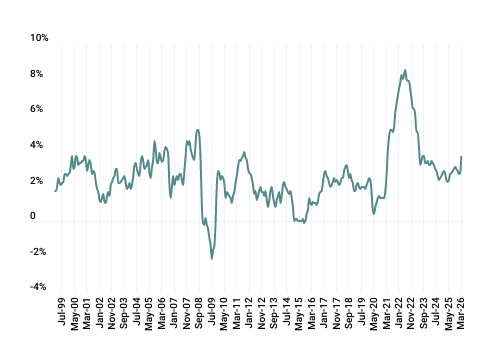
The CPI-U rose 0.9% in March on a seasonally adjusted basis, pushing the twelve-month all-items rate to 3.3%, up sharply from 2.4% in February and the highest reading since April 2024. The increase was driven almost entirely by energy, which surged 10.9% for the month as gasoline prices jumped 21.2%, the largest single-month increase on record for that series, accounting for roughly three-quarters of the headline advance. Core inflation remained contained at 0.2% for the month and year-over-year 2.6%. Shelter, historically the most persistent CPI component, rose 0.3% for the month and 3.0% year-over-year, its lowest annual reading since August 2021.

CoverImage_2026Q1_GDP
REAL GROSS DOMESTIC PRODUCT
25 YEARS THROUGH Q4 2025

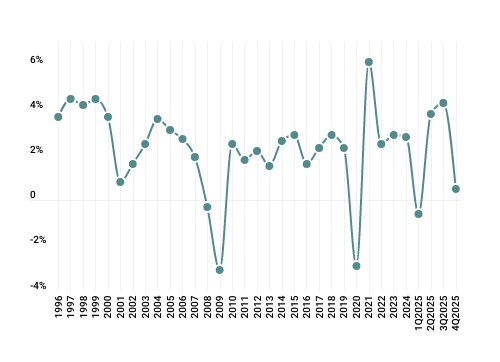
During Q4 2025, real GDP increased at an annualized rate of 0.5%, a sharp deceleration from 4.4% in the prior quarter, according to the BEA's third estimate. The headline figure was weighed down by declines in government spending and exports, with a further estimated 1.0% drag from reduced labor services during the October-November 2025 shutdown. Underlying private demand was more resilient: real final sales to private domestic purchasers grew 1.8%, supported by consumer spending and investment. Private services-producing industries increased 2.3%, partially offset by contractions in government and private goods-producing industries.

CoverImage_GMS_RetailSection
RETAIL SALES

Retail sales rose 0.6% in February and were up year-over-year 3.7%, with the December 2025 through February 2026 period up 3.1% compared to the same period a year ago. Non-store retailers and food services and drinking places were notable contributors to the year-over-year gain, while furniture and home furnishings sales continued to contract, reflecting persistent weakness in housing activity. These figures predate the US-Iran conflict; the impact of the associated energy shock is not yet reflected in the retail data.

CoverImage_2026Q1_UnemploymentRate
Unemployment RATE
25 YEARS THROUGH MARCH 2026

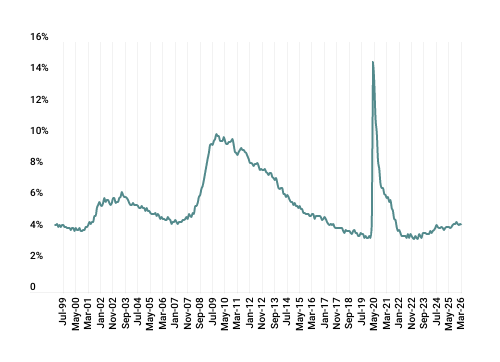
The labor market showed meaningful signs of softening in the first quarter. The unemployment rate held at 4.3%, while the labor-force participation rate edged down to 61.9%. The economy added 178,000 jobs in March, rebounding from a February decline of 133,000 distorted by a healthcare sector strike; healthcare led March gains with 76,000 additions, while construction added 26,000. The broader trend is less encouraging: the economy has averaged approximately 15,000 jobs per month over the past six months, compared to 78,000 over the same period one year earlier, and has experienced outright job losses in five of the past twelve months. Average hourly earnings rose 0.2% for the month and year-over-year 3.5%, the slowest annual pace since May 2021.

CoverImage_2026Q1_VIX
CBOE VIX DAILY CLOSING VALUES
LAST 10 YEARS

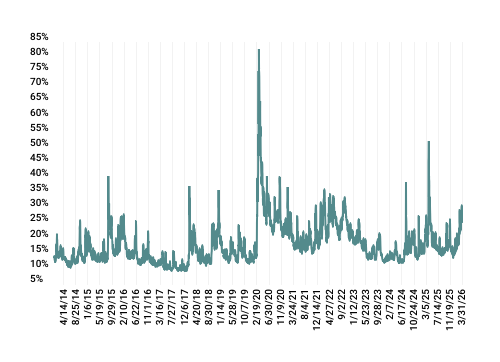
Market volatility rose meaningfully in the first quarter, with the VIX averaging approximately 21-22, above its long-term average and well above the subdued levels of late 2024. Volatility was driven by a convergence of concerns: tariff-related trade anxiety, a reassessment of AI capital expenditure, and mounting geopolitical risk as the US launched military operations against Iran in late March. The index spiked to 31.01 on March 27th, its highest level since last April's tariff turmoil, before partially recovering. The S&P 500 finished Q1 down approximately 4.6%, its worst quarter since 2022. For long-term institutional investors, the elevated VIX reflects genuine uncertainty around both the inflation and growth outlook, not simply near-term noise.

 
DOMESTIC EQUITIES


CPI
CPI

The Consumer Price Index for All Urban Consumers (CPI-U) increased 0.3% in December, following a 0.1% increase in November.  The all-items index rose 3.4% before seasonal adjustment over the previous twelve months.  Over the past twelve months, the major contributors include transportation services, up 9.7% (driven by motor-vehicle insurance, up 20.3%), tobacco and smoking products, up 7.8%, and shelter, up 6.2%.

GDP
GDP

During Q3 2023, real GDP rose at an annual rate of 4.9% followed by a 2.1% increase in Q2 2023.  The increase was driven by consumer spending and inventory investment; imports also increased. Overall, 14 of 22 industry groups contributed to real GDP growth in the third quarter; the value added from private goods-producing industries was particularly strong at 10.2%.

Retail Sales
Retail Sales

Total retail and food sales increased 0.3% and 4.1% month-to-date and year-to-date ending November 2023, respectively.  Total sales from September through November 2023 were up 3.4% compared to the same period one year ago; the percentage change over the same period was up 0.4%.  Significant contributors include non-store retailers and food services and drinking places. 

Unemployment
Unemployment
A total of 494,000 jobs were created in the fourth quarter of 2023, which did not outpace the previous quarter’s gains of 710,000.  The US economy added 216,000 jobs in November, which is below the twelve-month average monthly gain of 225,000. December’s notable job gains occurred within the following industries: government (+52,000), health care (+38,000), social assistance (+21,000), and construction (+17,000).
 
The unemployment rate remains unchanged from the previous quarter’s average at 3.7%.  The number of unemployed persons (6.3 million) experienced minimal net movement as well.  The labor force participation rate decreased by 0.3% in December (62.5%).
VIX
VIX

Market volatility, as measured by the VIX Index, had an average close in Q4 2023 at 15.29, trending up from Q3 (15.01) and down from Q2 (16.48).  The index has dropped below its five-year average of 20.58, reflecting positive investor sentiment and a high level of comfort with the overall direction of the economy.

GMS Table Templates
  Q4 2023 YTD   Q4 2023
YTD
Title
0%
0%
Title
0%
0%
Title
0%
0%
Title
0%
0%
Title
0%
0%
Title
0%
0%


  Q4 2023 YTD   Q4 2023
YTD
Large Cap Value
0%
0%
Large Cap Growth
0%
0%
Mid Cap Value
0%
0%
Mid Cap Growth
0%
0%
Small Cap Value
0%
0%
Small Cap Growth
0%
0%


  U.S. Large Cap U.S. Mid Cap U.S. Small Cap
  Q4 2023 YTD Q4 2023 YTD  Q4 2023 
YTD
Title
0%
0%
0%
0%
0%
0%
Title
0%
0%
0%
0%
0%
0%
Title
0%
0%
0%
0%
0%
0%
Title
0%
0%
0%
0%
0%
0%
Title
0%
0%
0%
0%
0%
0%
Title
0%
0%
0%
0%
0%
0%
Title
0%
0%
0%
0%
0%
0%
Title
0%
0%
0%
0%
0%
0%
Title
0%
0%
0%
0%
0%
0%
Title
0%
0%
0%
0%
0%
0%
Title
0%
0%
0%
0%
0%
0%
Title
0%
0%
0%
0%
0%
0%
Title
0%
0%
0%
0%
0%
0%


  Header Header
Header Q4 2023 YTD Q4 2023 YTD 
Title1
0%
0%
0%
0%
Title2
0%
0%
0%
0%
Title3
0%
0%
0%
0%
Title4
0%
0%
0%
0%
Title5
0%
0%
0%
0%


  Header Header
Header Q4 2023 Q4 2023
Title1
0%
0%
Title2
0%
0%
Title3
0%
0%
Title4
0%
0%
Title5
0%
0%


Country Best Performing Style
Title1
Value
Title2
Value
Title3
Value
Title4
Value
Title5
Value
Title6
Value
Title7
Value
Title8
Value
Title9
Value
Title10
Value
Title11
Value
Title12
Value
Title13
Value
Returns by style
  Q4 2023 YTD   Q4 2023
YTD
Large Cap Value
0%
0%
Large Cap Value
0%
0%
Mid Cap Value
0%
0%
Mid Cap Value
0%
0%
Small Cap Value
0%
0%
Small Cap Value
0%
0%


  Q4 2023 YTD   Q4 2023
YTD
Large Cap Value
0%
0%
Large Cap Growth
0%
0%
Mid Cap Value
0%
0%
Mid Cap Growth
0%
0%
Small Cap Value
0%
0%
Small Cap Growth
0%
0%


SECTOR Returns BY CAPITALIZATION
  U.S. Large Cap U.S. Mid Cap U.S. Small Cap
  Q4 2023 YTD Q4 2023 YTD  Q4 2023 
YTD
Basic Materials
0%
0%
0%
0%
0%
0%
Consumer Goods
0%
0%
0%
0%
0%
0%
Consumer Services
0%
0%
0%
0%
0%
0%
Financials
0%
0%
0%
0%
0%
0%
Health Care
0%
0%
0%
0%
0%
0%
Industrials
0%
0%
0%
0%
0%
0%
Oil & Gas
0%
0%
0%
0%
0%
0%
Real Estate
0%
0%
0%
0%
0%
0%
Technology
0%
0%
0%
0%
0%
0%
Telecommunications
0%
0%
0%
0%
0%
0%
Utilities
0%
0%
0%
0%
0%
0%
Source: Russell Investments & Industry Classification Benchmark
Large Cap: Russell Top 200 Index | Mid Cap: Russell Mid Cap Index | Small Cap: Russell 2000 Index


us valuations
  Quarter Ending 12/31/2023 Quarter Ending 9/30/2023
US Large Cap Equity Value Growth Value Growth 
Price/Earnings Ratio
0%
0%
0%
0%
IBES LT Growth (%)
0%
0%
0%
0%
1 Year Forward P/E Ratio
0%
0%
0%
0%
Negative Earnings (%)
0%
0%
0%
0%


  Quarter Ending 12/31/2023 Quarter Ending 9/30/2023
US Mid Cap Equity Value Growth Value Growth 
Price/Earnings Ratio
0%
0%
0%
0%
IBES LT Growth (%)
0%
0%
0%
0%
1 Year Forward P/E Ratio
0%
0%
0%
0%
Negative Earnings (%)
0%
0%
0%
0%


  Quarter Ending 12/31/2023 Quarter Ending 9/30/2023
US Small Cap Equity Value Growth Value Growth 
Price/Earnings Ratio
0%
0%
0%
0%
IBES LT Growth (%)
0%
0%
0%
0%
1 Year Forward P/E Ratio
0%
0%
0%
0%
Negative Earnings (%)
0%
0%
0%
0%


international valuations
  Quarter Ending 12/31/2023 Quarter Ending 9/30/2023
International Equity Value Growth Value Growth 
Price/Earnings Ratio
0%
0%
0%
0%
IBES LT Growth (%)
0%
0%
0%
0%
1 Year Forward P/E Ratio
0%
0%
0%
0%
Negative Earnings (%)
0%
0%
0%
0%


  Quarter Ending 12/31/2023 Quarter Ending 9/30/2023
Emerging Markets Equity Value Growth Value Growth 
Price/Earnings Ratio
0%
0%
0%
0%
IBES LT Growth (%)
0%
0%
0%
0%
1 Year Forward P/E Ratio
0%
0%
0%
0%
Negative Earnings (%)
0%
0%
0%
0%
Source: Russell Investments Total Equity Profile


non-us developed / emerging cap & style
  Q4 2023 YTD   Q4 2023
YTD
Large Cap Value
0%
0%
Large Cap Value
0%
0%
Mid Cap Value
0%
0%
Mid Cap Value
0%
0%
Small Cap Value
0%
0%
Small Cap Value
0%
0%


  Header Header
Header Q4 2023 Q4 2023
Title1
0%
0%
Title2
0%
0%
Title3
0%
0%
Title4
0%
0%
Title5
0%
0%


Country Best Performing Style
Australia
Value
Brazil
Value
Canada
Value
China
Value
France
Value
Germany
Value
Hong Kong
Value
Indonesia
Value
Italy
Value
Japan
Value
Mexico
Value
Singapore
Value
Spain
Value
Thailand
Value


GLOBAL EQUITIES
GLOBAL EQUITY PERFORMANCE

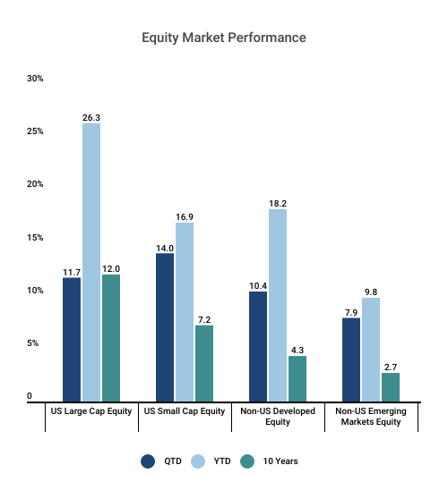
Global equity markets faced a turbulent first quarter, shaped decisively by the outbreak of US-Israel military conflict with Iran on February 28th and the subsequent closure of the Strait of Hormuz. The S&P 500 declined 4.6%, its weakest result since 2022, while the MSCI EAFE fell 1.2% and the MSCI Emerging Markets Index finished essentially flat at -0.1%, both meaningfully outperforming their US counterpart. The quarter began constructively, with broadening market leadership, renewed interest in AI infrastructure themes, and strong fund flows into international equities. That backdrop shifted abruptly in late February as the Middle East conflict sent oil prices sharply higher and rekindled inflation fears. The MSCI ACWI declined 3.2% on the quarter, with the software and SaaS drawdown as the primary US-specific headwind.

Within developed markets, performance was sharply divided between commodity-linked and energy-importing economies. Norway was the standout performer, gaining 31.5% as its energy and financial sectors benefited directly from surging oil prices. Portugal added 11.4%, supported by its cyclical and energy tilt. Denmark was the weakest developed market at -14.5%, reflecting continued pressure on its heavyweight healthcare and pharmaceutical names. Elevated energy costs and slowing growth expectations weighed on continental Europe broadly, dragging down Ireland (-10.2%), Germany (-8.5%), France (-5.4%), and Switzerland (-4.2%).

Within emerging markets, Latin America dominated as the region's commodity exposure and relative distance from Middle East supply disruptions worked in its favor. Colombia (+21.1%), Peru (+20.8%), and Brazil (+19.1%) were the top three performers, each benefiting from energy and materials strength. Korea (+16.5%) and Taiwan (+9.1%) also delivered positive returns driven by enthusiasm for AI-related hardware and semiconductor infrastructure, though both reversed sharply in March as the energy shock hit Asian markets. Indonesia (-20.7%) and China (-8.9%) were the quarter's notable laggards, negatively impacted by energy cost pressures.


row-spacer
row-spacer
US VALUATIONS

US equities are expected to grow earnings year-over-year 12.6% for Q1 2026, with eight of eleven sectors projected to increase earnings. Information technology (+45%), materials (+24%), financials (+15%), and utilities (+10%) lead these gains, while healthcare (-10%), communication services (-3%), and energy (-1%) are expected to post the most significant declines. Analyst estimates predict earnings and revenue growth of 18% and 9%, respectively, for full-year 2026.

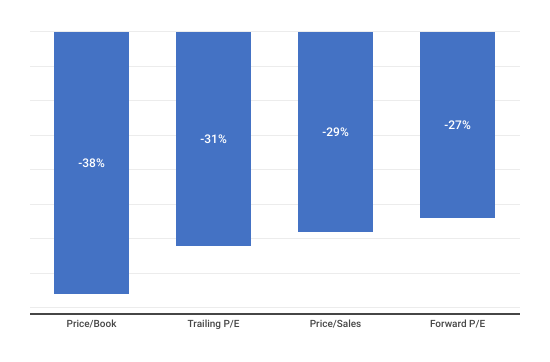
Value-style equities experienced multiple expansion while growth equities experienced compression. On a normalized basis, the S&P 500 remains expensive, trading at a CAPE more than two standard deviations above its long-term average.

INTERNATIONAL VALUATIONS

Non-US developed equity valuations increased for value-style equities and decreased for growth, with international equities continuing to trade at a wide discount relative to their long-run averages. Emerging-market valuations were relatively flat over the quarter and remain cheap on both an absolute and relative basis. Europe, Japan, and emerging markets are expected to grow earnings by 15%, 12%, and 38%, respectively, for full-year 2026.

 
HEDGE FUNDS
HEDGE FUND PERFORMANCE
 
PRIVATE EQUITY
PRIVATE EQUITY PERFORMANCE


FIXED INCOME
US SPREAD PRODUCTS

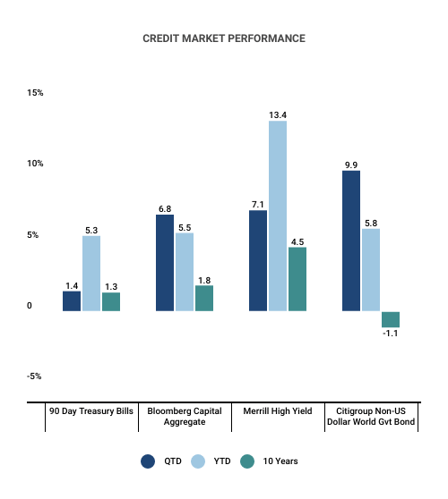
Investment-Grade Corporate Bonds: The market returned -50 bps for the quarter. Negative price effects caused by increases in US Treasury yields and spread widening overwhelmed the coupon return. Despite the geopolitical uncertainty and risk-off sentiment, the investment-grade corporate bond spread widened by only 11 bps (to 89 bps) and remains near its lowest level since 1998. Higher-quality issues outperformed: Aa-rated, +10 bps; A-rated, -50 bps; and Baa-rated corporates, -60 bps. Issuance was robust at $650 billion, an increase of 14% from the same quarter a year prior; anchored by Amazon’s $37 billion deal, the IG market logged $240 billion of total issuance in March (the second busiest month on record).

High-Yield Corporate Bonds: The market returned -50 bps for the quarter. Negative price effects caused by increases in US Treasury yields and spread widening overwhelmed the coupon return. Spreads widened by 51 bps (to 317 bps), still well below the long-term average (+485 bps). Higher-quality issues outperformed: BB-rated corporates, -30 bps; B-rated corporates, -60 bps; and Caa-rated corporates, -130 bps. The twelve-month trailing default rate for unsecured high-yield bonds is currently 119 bps and rising; however, when including distressed exchanges, this figure is 210 bps and approaching its long-term average (280 bps). Issuance was $85 billion, an increase of 9% from the same quarter a year prior; issuance fell just 13% from March the year prior.


Russell2000_shutterstock_2294146949

hello world


test-4-gms
GDP

During Q3 2023, real GDP rose at an annual rate of 4.9% followed by a 2.1% increase in Q2 2023.  The increase was driven by consumer spending and inventory investment; imports also increased. Overall, 14 of 22 industry groups contributed to real GDP growth in the third quarter; the value added from private goods-producing industries was particularly strong at 10.2%.

test-4-gms
Retail Sales

Total retail and food sales increased 0.3% and 4.1% month-to-date and year-to-date ending November 2023, respectively.  Total sales from September through November 2023 were up 3.4% compared to the same period one year ago; the percentage change over the same period was up 0.4%.  Significant contributors include non-store retailers and food services and drinking places. 

test-4-gms
Unemployment

A total of 494,000 jobs were created in the fourth quarter of 2023, which did not outpace the previous quarter’s gains of 710,000.  The US economy added 216,000 jobs in November, which is below the twelve-month average monthly gain of 225,000.  December’s notable job gains occurred within the following industries: government (+52,000), health care (+38,000), social assistance (+21,000), and construction (+17,000).

The unemployment rate remains unchanged from the previous quarter’s average at 3.7%.  The number of unemployed persons (6.3 million) experienced minimal net movement as well.  The labor force participation rate decreased by 0.3% in December (62.5%).

test-4-gms
VIX

During Q2 2023, real GDP rose at an annual rate of 2.1%, following a 2.2% increase in Q1. The increase was driven by state and local government spending, non-residential fixed investment, and consumer spending, partially offset by a decrease in exports; imports also decreased. Relative to Q1, the second quarter experienced a slowdown in consumer and federal government spending alongside the decline in exports, which drove the Q2 deceleration of real GDP.

 
MID CAP VALUE VS. GROWTH
ROLLING 1-YEAR PERFORMANCE VS. RUSSELL 2000
12/31/2013 TO 12/31/2023

LARGE CAP VALUE VS. GROWTH
 
ROLLING 1-YEAR PERFORMANCE VS. RUSSELL 2000
 
12/31/2013 TO 12/31/2023
 
 
Charts
YIELD CURVE

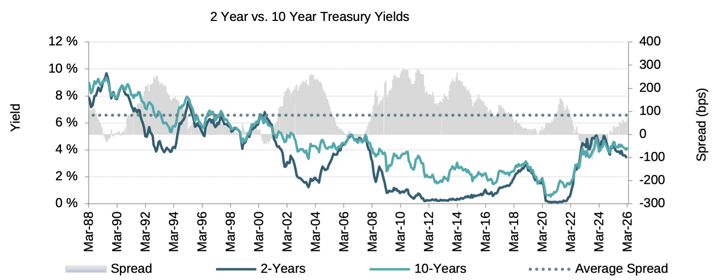
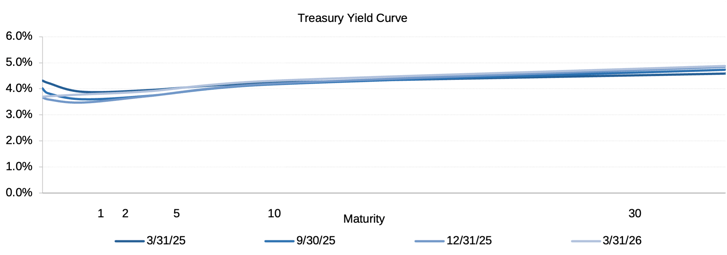
US Treasury yields rose while the curve flattened during the quarter. The two-year yield increased by 32 bps to 3.8% and the ten-year yield by 12 bps to 4.3%. The two-to-ten spread narrowed by 20 bps to settle at +51 bps; the spread has remained below the long-term average (+85 bps) since December 2021. Treasuries rallied through January and February on mild inflation and soft labor data, then reversed sharply as Middle East conflict drove energy prices higher. By the end of March, markets had priced out two expected 2026 rate cuts, with the sharpest yield increases concentrated at the front end of the curve. Longer maturities increased primarily on expectations of downside risks to tariff revenue and upside risks to defense expenditure; both may widen the federal deficit. Notably, the ‘5-year, 5-year’ forward breakeven inflation did not exit its well-trodden range of 2.0-2.5%. Generally, the US economy appears much less affected than the rest of the world by the conflict from both a growth and inflation perspective.
 

CoverImage_2026Q1_TreasuryYields


CoverImage_2026Q1_TreasuryYieldCurve


Love these and want more?

Enter your email address below and we will let you know when we add new resources.