Marcus Aurelius didn’t have a Bloomberg terminal, but he had something comparably useful, the conviction that all things return to their fundamental state.
Amor fati, love of fate, is sometimes confused with resignation, but that’s a too-myopic reading. In essence, it is simply clear-sightedness, and when applied correctly, an edge. The boulder reaches the top; the hill takes it back; the cycle repeats. It has always worked this way.
The stoic-minded thinkers of an earlier age built their philosophies around one irreducible insight: fate is not your enemy if you stop pretending it won’t arrive. For our purposes, mean reversion is synonymous with fate. The question is whether your portfolio has made peace with it.
The term gets used loosely, so it’s worth being precise. Mean reversion is simply the tendency of returns to migrate back toward long-run historical averages after extended periods above or below them. It does not require a crash. The S&P 500 has delivered a five-year nominal return of approximately 14.4%, well above any defensible long-term expectation. A gravitational reset to the mean will not necessarily announce its arrival as a singular or easily definable event; it can come quietly or obliquely, as a decade of flat real returns that slowly erodes purchasing power while committees congratulate themselves on avoiding volatility. Such a reversion is harder to see as it’s happening and harder to explain after the fact.
Any concentration problem sharpens this. When roughly 30–40% of the S&P 500 is held in a handful of companies, the index is not a diversified instrument. A potential full reversion from current valuations would be devastating to portfolios built around that concentration; even a partial reversion of 50–75% would produce a ‘lost decade’ for anyone who bought near the summit, while a modest scenario in the 0–25% range could meaningfully reshape relative performance. An investor that understands amor fati doesn’t need to know if or when which of these arrives, but continually builds for the range.
Mean reversion doesn’t require a crash. It can arrive quietly, through a decade of flat real returns that slowly erode purchasing power while committees congratulate themselves on avoiding volatility.
The chart below shows a pattern. Since 1835, every period of dramatic market concentration has resolved the same way, not always quickly or painfully, but always. The AI Big 10 now sits at approximately 40% of US market cap, matching the peak concentration of every prior episode in the modern era.
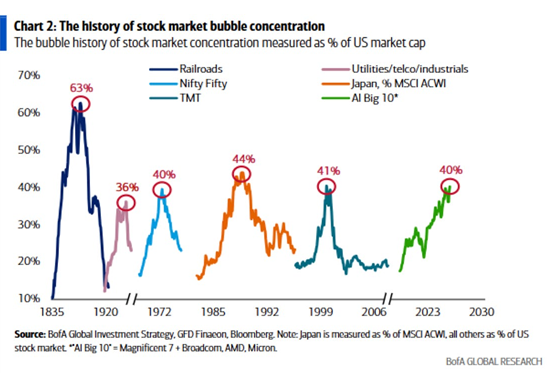
The Nifty Fifty, the TMT boom, the housing cycle, the venture surge of 2020 and 2021: in each case, the dominant thesis was that the concentration was justified and the businesses were genuinely dominant, the moats genuinely deep, the growth genuinely durable. In most cases that proved true; Cisco is still a powerful business and Intel endures. These stocks, however, purchased at the peak of their popularity, were demonstrably not good investments for the decade that followed. Microsoft is currently the exception that proves the rule relative to comparable episodes. However, the lesson of the exception is not that they exist, but that you cannot build a portfolio on the assumption that you are holding the one that will be.
The capex paradox. Projected AI capital expenditure over the next several years has reached levels that have no historical precedent and no plausible near-term revenue model to service them at current efficiency levels. The potential but far-from-certain breakthrough that resolves this paradox, dramatically more efficient large language models, would simultaneously be a key event that could deflate the semiconductor premium. NVIDIA at elevated multiples of revenue is priced for permanent growth.
The valuation arithmetic. There are hundreds of public companies generating comparable revenues to some of the most richly valued names in today's market. The median among large-revenue businesses trades at a fraction of the multiples commanded by the current market darlings. This is not an argument that dominant businesses are bad businesses by a long shot, but it is an argument about what narrative commands over fundamentals and what mean reversion could look like when that gap closes. The SpaceX IPO, priced at $135 per share against roughly 96x trailing revenues on a business that reported a GAAP net loss of nearly $5 billion in 2025, is the current example: a company valued not on earnings but on narrative control. Emeritus Professor Jay Ritter's long-run IPO database at the University of Florida's Warrington College of Business shows that companies that went public above 40x price-to-sales lost roughly 45% over three years on an absolute basis and trailed style-matched peers by nearly 76 percentage points; those that entered below 5x returned over 40%. For any newly public company combining that entry multiple with a thin initial float and a staggered lock-up, the historical record does not treat that combination generously.
The regulatory vacuum. The dismantling of regulatory oversight across financial markets from crypto to derivatives to public-market speculation removes certain circuit breakers that historically slowed the acceleration of excess. Prior episodes of irrational concentration had greater friction by definition. The projections now circulating from major underwriters are consistent with this: Goldman Sachs projects xAI revenue growing from $3.2 billion to $322 billion by 2030; Morgan Stanley projects SpaceX generating $3.4 trillion in revenue and $2.7 trillion in adjusted EBITDA by 2040. The scale of these numbers makes us wonder if they are even taken seriously by the people who publish them, but in an environment without accountability, they are stated with enough frequency and institutional authority that they begin to shape the conversation. The absence of consequence for forecasts that will never arrive is itself a traditional guardrail that has been removed.
However, an investor who has watched Mag 7 concentration compound returns for the better part of a decade could have a legitimate question: why should the next decade look any different?
Or, at what point does concentration stop being a risk and start being the market? We would say the answer is not so much about right or wrong; it’s that the structural argument has proportionally strengthened as concentration has deepened. The further any system moves from its mean, the more potential energy accumulates for the return journey. That is not a prediction or a market call, but basic physics and the laws of finance.
Committees facing this environment are confronted with three coherent paths:
Door 1:
Maintain conviction, absorb tracking error, and wait for mean reversion to validate the thesis.
Door 2:
Moderate the underweight with partial index or mega-cap exposure as a hedge against continued momentum.
Door 3:
Align with the index and accept concentration as the price of near-term parity.
Each door has a real cost. Door 1 carries continued tracking error and the organizational patience required to hold through discomfort. Door 2 introduces a structural tension between conviction and comfort that is difficult to manage cleanly over time. Door 3 purchases short-term relief at the price of the very risk management that defines Crewcial's mandate for long-term, mission-driven capital.
There is a complementary frame worth naming here. In contemplating the inescapability of fate’s structure, Albert Camus confronted something rawer: the absurd, or the gap between what we demand or expect of the world and what the world is able to deliver. In The Myth of Sisyphus, Camus takes one of the most punishing images in Western mythology, a man condemned to push a boulder to a summit it will never hold, and arrives at a counterintuitive conclusion. Sisyphus is not a figure of futility. He is the embodiment of defiance. He knows the boulder will fall, yet he pushes it anyway. He has no other choice, otherwise the boulder simply rolls away, is lost, and the game is over. And in that full, clear-eyed ownership of a struggle without guarantee of resolution, Camus finds something that looks like dignity, and perhaps even joy.
Don't let this elemental existentialism scare you. The somewhat less fraught parallel for a long-term investor is holding an unpopular conviction while the gap to a runaway benchmark widens and the rationale for staying the course grows harder to deliver. The tracking error is the boulder; the benchmark is the hill. Sisyphus knows the boulder will fall; that is not the punishment, it’s the point. The investor who understands mean reversion knows the same thing. Camus's counsel is neither to deny the weight nor pretend the summit is closer than it is. It is to own the climb so completely that the vindication, whenever it comes, is almost beside the point (which of course, in our case, it is not).
“The struggle itself toward the heights is enough to fill a man's heart,' he wrote. 'One must imagine Sisyphus happy.” In our case, the struggle not to be overwhelmed by the now-almost-vertical boulder is enough. One must understand a diversified portfolio’s resilience.
Together, these models of thought arrive at the same posture by different routes. Amor fati says love what’s coming, because it is the nature of things. Camus says embrace the struggle fully, because the struggle is what you have. Neither requires certainty about timing, but both require clarity about what you are actually doing and why.
Some of Crewcial’s current portfolios carry meaningful exposure to AI beneficiaries, and we are not anti-AI, but we support a portfolio approach that declines to pay any price for any narrative and maintains breadth, manager diversity, and liquidity sufficient to act when conditions shift. The diversification across geographies, market capitalizations, styles, and manager types is not a hedge against ‘the good times.’ We don’t know at which point the hill becomes too steep, we can only see that historically it does in each case, and generally at a roughly pre-defined level, so we have built accordingly.
The goal is to ensure that whatever path a committee chooses, they choose it with clear eyes and full information. Committees that choose index concentration knowingly, having seen the range of outcomes, are making a governance decision. Committees that simply drift into it are just making a mistake.
Marcus Aurelius governed the most powerful empire in Europe at the time and spent his private hours writing reminders to himself that nothing lasts, that the cycle is the whole point, and that the only honest response to inevitability is to love it rather than fight it. He was not bearish on Rome; he was realistic about its ultimate trajectory based on well-established precedent. And he was right, with the start of the Empire’s long decline dated to his son and successor.
We are fully committed to long-term capital growth, fully at peace with what the cycle will eventually demand, and fully prepared for the conversation when it arrives. Part of that preparation is making clear to clients that they have genuine choices, that passive acceptance of index concentration is a decision, not an inevitability, and that the current era’s most durable grift may be the one that persuades investors there are no other reasonable options. To embrace is not to predict the future but to be prepared for it. The people who do this well are not the ones who never feel the pull of the consensus. They are the ones who feel it acutely, yet hold anyway.