There are currently more than 60 armed global conflicts around the world, the most of any period since World War II, most recently punctuated by the United States' conflict with Iran. In AI, we are witness to one of the great technological leaps in human history. Policy shifts domestically and abroad are rewriting the rules and norms of doing business.
Every generation of investors is convinced it has drawn the short straw, and that its particular moment is uniquely treacherous. Sometimes that conviction is self-serving. Sometimes it is correct. The investment landscape that has taken shape over the past several years belongs, we would argue, in the latter category. The equity and bond markets of 2025 and into 2026 are not simply volatile in the ordinary, cyclical sense. They are structurally complex in ways that confound passive solutions, reward careful thinking, and punish the kind of indiscriminate index exposure that worked beautifully during the long, low-volatility bull market of the prior decade.
The conditions that made passive investing so attractive (narrow dispersion, Fed predictability, a reliable stock-bond relationship, and a handful of mega-cap names that seemingly could not lose) have either deteriorated or reversed. The long-run aggregate data on active management is not flattering, but we believe this matters less than it appears to. The more productive question is not whether the average active manager adds value over a 20-year period, but whether this environment, characterized by historic index concentration, a bond market navigating genuinely new terrain, and a macro backdrop that could charitably be described as having a wide range of outcomes, creates conditions in which skilled, disciplined managers can do something a passive vehicle simply cannot. We believe it does.
The Equity Market: Concentration, Distortion, and Hidden Risk
The S&P 500 has delivered three consecutive years of double-digit gains: 24% in 2023, 23% in 2024, and 16% in 2025. That is a remarkable run, and it has understandably made passive index investing look like the only game worth playing. But the structure of this market deserves more scrutiny than the headline numbers invite.
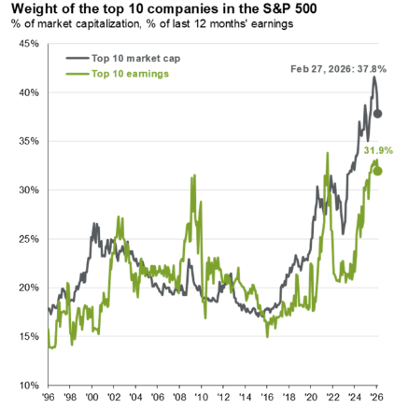
The top ten companies in the S&P 500 now account for roughly 41% of the index's total weight; the concentration level has nearly doubled in just the past decade and now sits at its highest point in half a century. The Magnificent Seven alone represent approximately 35% of total market capitalization. This is not diversification, but a very large bet on a very small number of companies, most of which are deeply exposed to a single theme, artificial intelligence, whose ultimate returns on the hundreds of billions of dollars being invested into the technology's infrastructure remain genuinely uncertain. In 2025, AI-related enterprises accounted for roughly 80% of gains in the US market.
The Shiller CAPE ratio exceeded 40 for the first time since the dot-com crash. The market-cap-weighted S&P 500 now trades at nearly a 30% premium to its equal-weighted counterpart, up from about 13% just prior to the pandemic, reflecting a market in which the top ten stocks represent 38% of index weight but are expected to generate only about 32% of its earnings. That gap between weight and earnings contribution has historically been a warning sign, not a green light.
To be fair, this is not the dot-com bubble rerun that some might suggest. The companies leading this market are real businesses with real earnings and real competitive advantages. However, elevated valuations at extreme concentration, even in high-quality businesses, limit the margin of safety for the passive investor who has no ability to exercise judgment about price; the active manager, by contrast, can.
Dispersion makes the opportunity set even more interesting. Sector dispersion in 2025 reached levels not seen since the pandemic era, with a roughly 25-percentage-point gap between the best and worst-performing sectors. The Magnificent Seven itself fractured, with a 60-percentage-point spread in individual returns as fundamentals began to reassert themselves over narrative. When the market is that dispersed, the ability to distinguish between businesses (to do the right work, hold the right names, and avoid the right landmines) is worth something.
The Bond Market: Structural Shifts and the Return of Complexity
The bond market that most investors learned to navigate no longer really exists. For the better part of a decade following the financial crisis, bonds were simple: rates were pinned to the floor, the Fed telegraphed its every move, and the inverse correlation between stocks and bonds was as reliable as any relationship in finance.
That world is gone.
The return of term premium, the additional yield investors demand for lending money over longer duration, has been one of the defining developments of the past two years. Ten-year Treasury yields spent most of 2025 above 4%, persisting there despite multiple rounds of Fed rate cuts. That stubbornness reflects a structural reality: longer-dated bonds are increasingly being driven not by what the Fed does, but by what the Treasury needs. The US government's borrowing requirements have grown to a point where bond issuance is straining the market's capacity to absorb this vast supply gracefully. T. Rowe Price flagged this dynamic in July 2025, noting that the medium- and long-maturity Treasury market had exhibited more limited liquidity than usual, as evidenced by the rapid yield spike following the April tariff announcement. When fiscal dynamics are driving long-end yields independent of the Fed, the old playbook is not just incomplete; it is actively misleading.
The erosion of the stock-bond correlation compounds the problem. The defining feature of bonds in a balanced portfolio has always been that they go up when stocks go down. That relationship weakened materially in 2022, when both asset classes posted significant losses simultaneously. Fidelity has acknowledged that the exception scenario of high inflation or rate increases driven by deficit financing is precisely the environment that appears most plausible going forward. In other words, the scenario in which bonds fail to provide their traditional cushion is a live possibility as opposed to merely a tail risk.
In this environment, active management in fixed income is not a luxury. The bond universe is enormous and heterogeneous (investment grade, high yield, mortgage-backed, emerging markets, TIPS, municipals, short-duration, long-duration) and performance differentials between categories in a complex macro environment can be dramatic. The active manager who can adjust duration dynamically, rotate across sectors, and avoid credits whose fundamentals are quietly deteriorating adds real value. More valuable is the advisor who can steer through the noise presented in such a dynamic market. The ability to rebalance portfolios and tactically weight across the aforementioned asset classes becomes a genuine value-add lever as the homogeneity unwinds. For example, early consensus appeared to be that private credit was a panacea for debt investors who both sought yield and limited downside risk. In 2026, headlines highlighting limited liquidity, massive redemptions, and necessary gating are ominously echoing those of the Global Financial Crisis. To avoid this trap, investors must apply sound, independent judgment about where risk is being mispriced. In a market this complex, that capacity to see clearly, act deliberately, and steer through noise is what separates a trusted institutional advisor from a conduit.
The Macro Picture: Uncertainty as a Permanent Feature
If the equity and bond markets have become more complex on their own terms, the macro environment surrounding them has become something approaching genuinely novel. The sources of uncertainty investors face today are not the familiar cyclical variety. They are structural, multiple, and mutually reinforcing in ways that make understanding the distribution of outcomes unusually difficult.
Geopolitical Risk
The conflict with Iran, while still in its early stages, introduces a range of outcomes that is genuinely unknowable. The first-order impacts, around energy and defense companies catching a bid, are predictable and appropriate. The more consequential question is what comes next. Historically, equity markets lose around 5% at the onset of conflict, bottom roughly three weeks in, and recover losses within six weeks on average. The wildcard is when conflict impacts the broader economy. A closure of the Strait of Hormuz has already pushed oil prices meaningfully higher. That energy price spike arrives at a moment when AI infrastructure buildout is straining an already antiquated electric grid, showing up in household and corporate energy bills alike. Whether this proves a short-duration affair or a lasting campaign that embeds higher energy costs across the economy remains the open question.
Trade Policy and Tariffs
The trade policy that emerged in 2025 represented the highest potential US tariff rates in nearly a century. The supply-chain shock it introduced is still working its way through corporate earnings and capital allocation decisions. Tariff uncertainty has depressed M&A activity, complicated the Federal Reserve's reaction function, and created a wide range of outcomes for individual companies depending on supply chain geography, pricing power, and end-market exposure. This is idiosyncratic risk, the kind that affects companies very differently depending on their specific circumstances, and such risk is precisely the kind that rewards bottom-up analysis. The passive investor owns the winners and losers indiscriminately, whereas the active manager does not have to.
The Federal Reserve's Uncertain Path
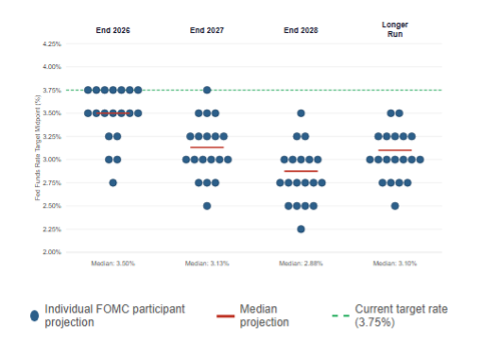
The FOMC dot plot as of late 2025 reflected a remarkable dispersion of views among committee members, with a wide range of expectations for the policy rate trajectory signaling anything but consensus. Markets are pricing in one to two additional rate cuts in 2026, but that base case could unravel if inflation surprises to the upside, a scenario that tariff dynamics, ongoing supply chain realignment, and the AI- and conflict-driven energy spike make more plausible than the consensus acknowledges.
Figure 2. FOMC Dot Plot — reflecting wide dispersion in rate trajectory expectations among committee members. Source: Federal Reserve / Charles Schwab.
The Active Management Debate: What the Data Actually Says
Intellectual honesty is required here; the long-run data on active management is not good. The S&P Indices Versus Active (SPIVA) scorecard found that 94.1% of all domestic equity funds underperformed the S&P 1500 Composite Index over the 20-year period ending in 2024. That number deserves to sit in your thoughts for a moment. Active management in the aggregate has been a poor bet over the long haul, and fee drag is a meaningful part of why.
But aggregate numbers are more often the beginning of the analysis, not the end of it. The research on Active Share, the measure introduced by Cremers and Petajisto (2009) that captures the percentage of a fund's holdings that differ from its benchmark, is considerably more instructive. The picture it paints raises a pointed question: how much of the active management underperformance reflected in the SPIVA data was ever truly active?
The Secular Decline of Genuine Active Management
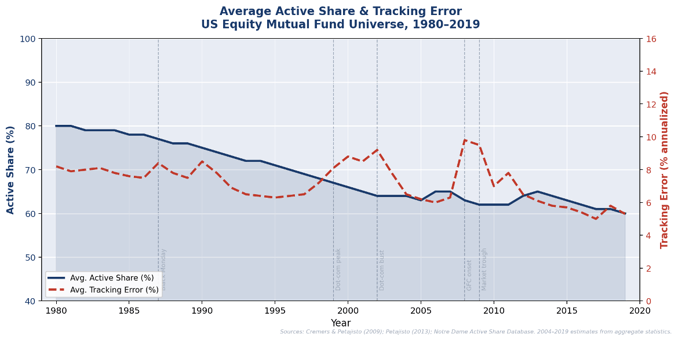
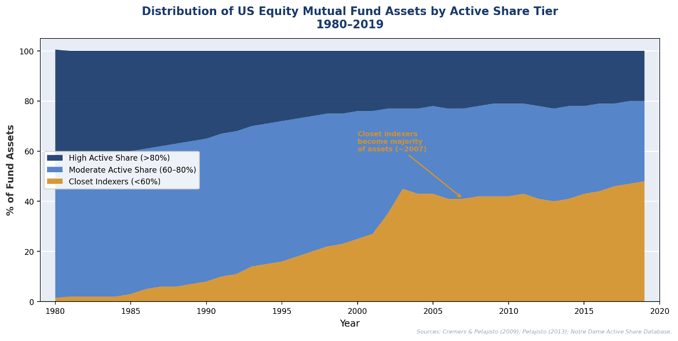
Average Active Share across the US equity mutual fund universe fell from approximately 80% in 1980 to around 60% by 2019. More striking is what happened at the tails: funds with Active Share above 80%, the genuinely conviction-driven funds, fell from 43% of industry assets in 1980 to roughly 20% by 2019. Meanwhile, closet indexers, those funds charging active fees while hugging the benchmark, grew from less than 2% of assets to nearly half.
This structural shift matters enormously when interpreting the aggregate underperformance data. By 2019, closet indexers, barely distinguishable from index products in terms of return behavior, yet charging materially higher fees, had become the largest single tier by assets. These funds were almost structurally guaranteed to underperform after fees. Including them in the aggregate active management scorecard is analytically valid but interpretively highly misleading, because they were never really active.
There is a productive tension here worth naming. The SPIVA data and the Active Share research are not in contradiction; they are measuring different things. SPIVA captures what happened to the industry in aggregate. Active Share research captures what happened to managers who actually took conviction-based positions. The implication is not that active management as a category is vindicated. It is that the relevant question is not "active vs. passive" but "what kind of active, in what environment, managed by whom."
Tracking Error: A Necessary but Insufficient Measure
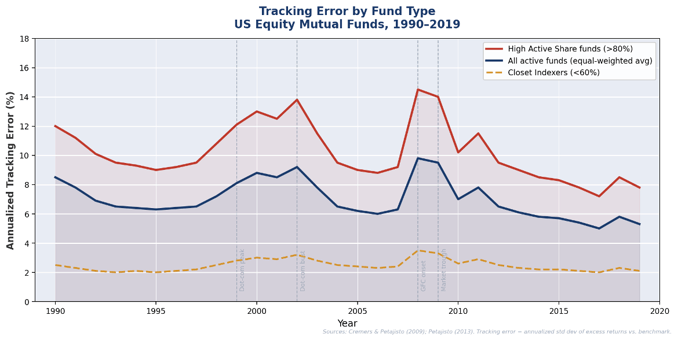
High tracking error without high Active Share often reflects factor or sector bets rather than individual stock selection. Factor bets (tilts toward size, value, or momentum) do not reliably predict outperformance in the same way that stock-level Active Share does. A fund can exhibit elevated tracking error through systematic exposures while never actually making a judgment about an individual business. Both measures are necessary for a complete assessment of what a manager is actually doing.
Figure 5. Average annualized tracking error by Active Share tier: High Active Share funds (>80%, red), all active funds (navy), and Closet Indexers (<60%, gold dashed). US equity mutual funds, 1990–2019. Source: Cremers & Petajisto (2009); Notre Dame Active Share Database.
High Active Share funds have consistently exhibited tracking errors in the 8–14% range, with spikes during market dislocations reflecting the concentrated, idiosyncratic nature of their holdings. Closet indexers have maintained tracking errors of approximately 2–3% throughout the same period. The New York Attorney General estimated in 2018 that investors in closet-indexing funds pay active management fees for essentially passive exposure, resulting in billions of dollars in excess fees industry-wide.
Why the Current Environment Changes the Calculus
The extended run of passive outperformance occurred against the backdrop of a very specific market structure: a narrow, momentum-driven bull market powered by a handful of mega-cap growth names, with suppressed volatility and tight cross-sectional dispersion. In that kind of market, the average active manager running a more diversified portfolio cannot afford to concentrate in the same names as the index at the same weights and will therefore underperform. That is not evidence that active management is broken, just that specific market structures advantage specific approaches.
Flip the environment, and the story changes. From 2000 to 2009, active outperformed passive nine out of ten years. Over the full 35-year stretch from 1990 through 2024, active and passive have each led roughly half the time. The current consensus that passive has definitively won is an extrapolation from a specific regime, not a universal law. Markets remain cyclical. The conditions that rewarded passive so handsomely (narrow dispersion, index concentration, predictable monetary policy) are precisely the conditions that are now reversing.
Dispersion is the active manager's oxygen. Large-cap stock-level dispersion in 2025 was above the historical average and above the prior two years. The CBOE S&P 500 Dispersion Index stood at 33.81 as of mid-January 2026, reflecting elevated expectations for differentiated stock returns. And the first half of 2025, amid tariff-related turmoil and real macro uncertainty, produced a 46% outperformance rate among large-cap active managers (which, as a reminder, is a group that includes our closet indexers). Not a majority, but a meaningful step up from the long-run average. When the environment gets genuinely complicated, the gap between skilled and unskilled managers widens, which is a feature of the current moment.
Where Active Management Makes the Most Sense
Of course, not all active management is worth paying for, but the closet indexer is not what we are talking about. The fee drag on genuinely underperforming active management is real and compounds over time. Identifying true conviction-based, stock-level differentiation from the benchmark is a core fiduciary responsibility for anyone allocating to active strategies.
What the current environment argues for, specifically, is active management that is genuinely active: concentrated enough to reflect real conviction, willing to deviate meaningfully from benchmark weights, and grounded in the kind of bottom-up fundamental work that produces differentiated views on individual securities.
Active management earns its fee most reliably where markets are least efficient: small- and mid-cap equities, where analyst coverage is thin and information asymmetries persist; credit markets, where careful selection sidesteps defaults and capitalizes on spread volatility; and international and emerging markets, where local knowledge and a less efficiently-priced universe create genuine edge.
More broadly, in this environment, the active manager's ability to simply not own something is enormously undervalued. The passive investor holding the S&P 500 today is long every AI-exposed mega-cap name at whatever weight the market has assigned, regardless of whether those valuations make sense, the AI capital expenditure will generate adequate returns, or the concentration is something they would consciously choose. The active manager can look at that concentration, those valuations, and the fiscal and macro environment surrounding them, then make a judgment. That judgment may be wrong, but having the ability to make it is worth something, especially at this particular moment.
Conclusion: Patience, Discernment, and a Long-Term Focus
Markets eventually tell the truth. Narratives, momentum, and index concentration runs, but then, at some point, fundamentals reassert themselves. We do not know exactly when that happens here, or what the catalyst will be. Nobody does. But the setup of historic valuations, extreme concentration, a bond market navigating genuinely new terrain, and a macro backdrop thick with live risks is not one that particularly favors the passive investor who has outsourced all judgment to the index.
Passive investing, at its best, is a bet that the market is efficient enough that no one can beat it consistently. That bet has paid off handsomely in recent years, in a very specific market environment. But efficiency is not uniformly distributed; the right active manager, applied in the right spot, who is patient, genuinely differentiated, willing to hold convictions when the narrative runs against them, and disciplined enough to pass on businesses they cannot underwrite at current prices, offers something no index fund can replicate: judgment, plain and simple. In a market this complicated, that is no small thing.
The question, as ever, is not whether active management in aggregate beats its benchmark The question is whether this environment, at this moment, tilts the odds in favor of skilled, disciplined, differentiated managers in a way that the prior decade did not. We think it does. And we believe the investors who recognize that early will be glad they did.
Additional Sources
S&P Dow Jones Indices / Indexology Blog, "2026 Is the Year of the Stock Picker?" (Jan. 13, 2026). StockTitan Market Database, "Stock Market 2025 Recap: Winners, Losers & Sector Analysis" (Jan. 3, 2026). RBC Wealth Management, "The Great Narrowing: S&P 500 Concentration" (Jan. 23, 2026). iShares / BlackRock, "Are AI Stocks in a Bubble? Why This Isn't a Dot-Com Redux" (2025). Fortune, "Is the AI Boom a Bubble Waiting to Pop?" (Jan. 4, 2026).
Fidelity, "Bond Market Outlook 2026" (Nov. 26, 2025). Charles Schwab, "The Bond Market in 2026: What Could Go Wrong?" and "2026 Outlook: Treasury Bonds and Fixed Income." AInvest, "Active ETFs Outperform Passive Strategies in 2025's Volatile High-Yield Markets" (Jul. 27, 2025). LPL Financial, "How Stocks React to Crisis" (Apr. 16, 2024).
Petajisto, A. (2013). "Active Share and Mutual Fund Performance." Financial Analysts Journal, 69(4). Cremers, M., Ferreira, M., Matos, P., & Starks, L. (2016). "Indexing and Active Fund Management: International Evidence." Journal of Financial Economics, 120(3), 539–560.
This commentary is prepared by Crewcial Partners for informational purposes only and does not constitute investment advice. Past performance is not indicative of future results.
 Kyle Marmelstein


 Jonathan Goldberg : September 3, 2026