
3 min read

CIRCULAR REASONING : WHAT NVIDIA'S BLOWOUT QUARTER OMITS

CIRCULAR REASONING : WHAT NVIDIA'S BLOWOUT QUARTER OMITS
4:47

Every week I get a rough sense of how things probably went before the facts are in, a continuum that runs from optimism to dread. Once the numbers are in, that turns to surprise or disappointment. Well, this week was a mildly positive surprise, which surprised me, given the market’s reaction to another “blow-out” earnings report from NVIDIA, the mini-boom going on in crypto, and the simple fact that we still seem a long way from rational pricing.

Something interesting seems to be quietly happening. Chip stocks and the mega-cap AI names are either down or producing anemic returns while a number of software names are resetting at higher prices. Not much of a surprise, really. Pricing for the year ending June 30 was panic-driven; that kind of high-emotion investing always burns out, which leaves room for at least a little rational thinking to kick in.

Back to NVIDIA. They posted another “blow-out” revenue and earnings report. The stock rose the next day, but gave back more than half of that gain the day after.

If I were in their shoes, the biggest concern I’d have is that the hype machine just isn’t landing the way it did a few months ago. The dichotomy between valuation, momentum, popularity, and a growing understanding of the fragility of AI buildout financing balances on a tightrope. An early sign came about a month ago, when NVIDIA announced it was backstopping OpenAI’s Ohio data center; the market briefly, and mysteriously, pivoted from treating every dollar of AI capex as a sign of financial success to actually considering debt levels and return on capital.

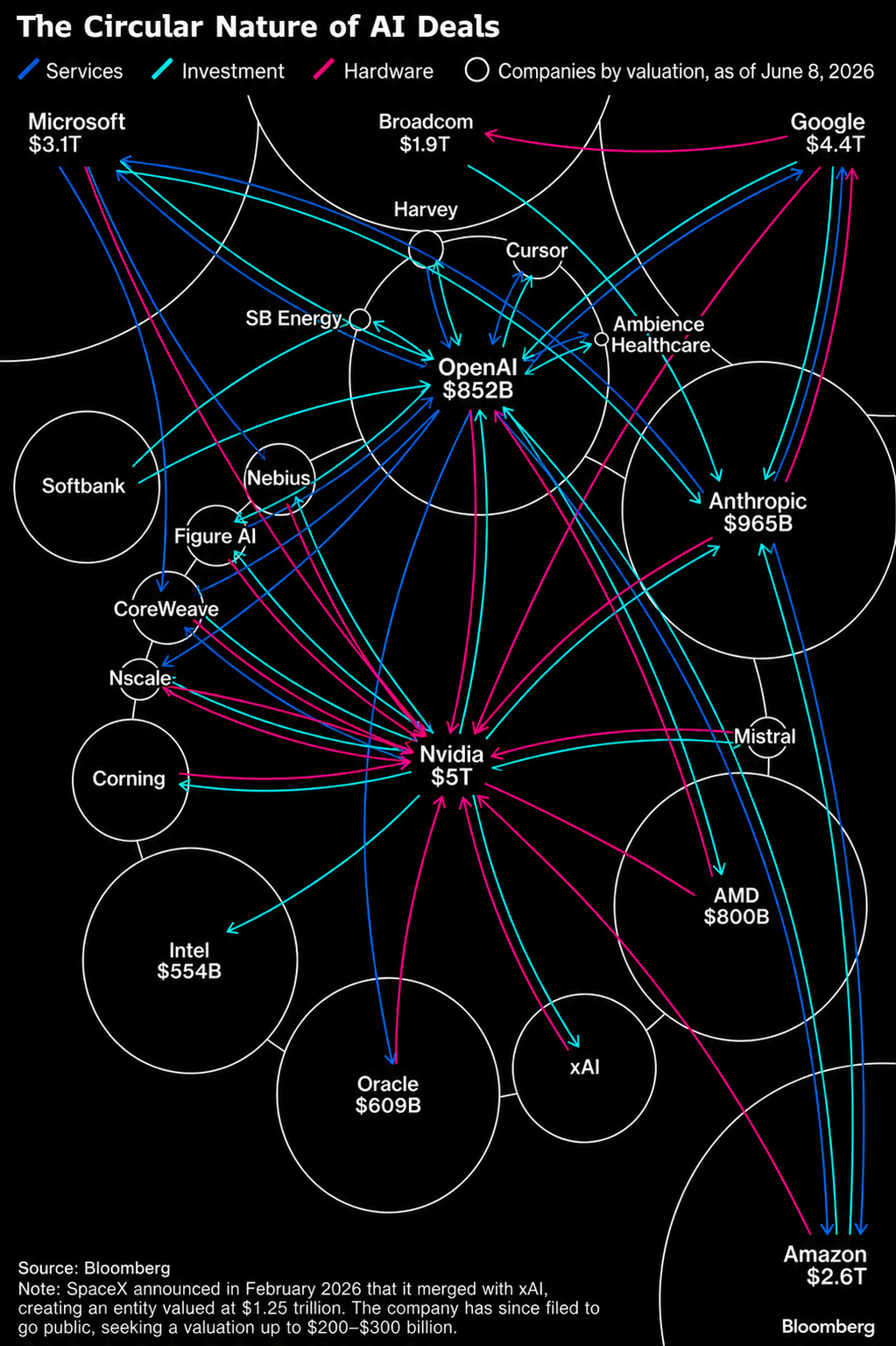
On Wednesday’s conference call, management tried to address the crux of the issue directly, which is really at the heart of the matter. They said some people see this as “circular financing,” but “we see it differently.” The CFO, Colette Kress, then indicated that roughly a quarter of next year’s revenue will come from companies in which NVIDIA has funded or invested.

For anyone who needs the refresher, circular financing is when a company provides its own customers with the money to buy its product; it juices demand above what those customers could afford, or would spend, if it were their own money.

Exhibit
The Circular Nature of AI Deals
Network diagram of services, investment, and hardware deals among major AI companies, sized by valuation as of June 8, 2026. Source: Bloomberg.

Source: Bloomberg. Companies by valuation, as of June 8, 2026. Note: SpaceX announced in February 2026 that it merged with xAI, creating an entity valued at $1.25 trillion. The company has since filed to go public at a market value of almost $1.77 trillion.

For the AI community, this is all about progress. Right now, the technology isn’t close to worth what’s being invested in it. But the future, they say, is going to be amazing, and we’ll never get there without spending a ton of cash now. What gets conveniently left out is that the future might not be as rosy as advertised and it’s still not clear we can afford this even if it works.

Here’s a small example of what misdirection looks like. Why give a projection of next year’s revenue rather than just disclosing this year’s number, which is a simple fact? I don’t know. Maybe the number is too large. Maybe predictions are just easier to forget than facts are to check. An honest disclosure would give you both and let you draw your own conclusions. It’s become an old-fashioned idea, but if you just give people the facts, they can draw them themselves.

Maybe predictions are just easier to forget than facts are to check.

Still, there are clouds on the horizon. Jeff Gundlach, the DoubleLine Capital bond investor known as the “Bond King,” recently compared using semiconductor chips as collateral for 30-year debt to backing a 30-year asset-backed security with a warehouse of, in his words, “newly engineered bananas of unknown life.” The point being that chips, like bananas, don’t have 30-year lives. It’s a good line, and a true one.

For me, I’m about as sure as I can be that I don’t possess some skill or wiring that lets me see things other people can’t. And yet the math behind AI capex is hard to look away from. Those two ideas shouldn’t be able to coexist. How can we see something the market doesn’t?

I don’t have a great answer. I suppose we won’t need one until the day comes when we’re explaining how we saw this clearly and others didn’t.

This commentary is provided for informational purposes only and does not constitute investment advice. Past performance is not indicative of future results. All investments involve risk. Crewcial Partners LLC is a Securities and Exchange Commission registered investment advisor.

© 2026 Crewcial Partners. All rights reserved.

THINKING STRAIGHT ABOUT AI

4 min read

THINKING STRAIGHT ABOUT AI

Every few decades, markets find a story too powerful to ignore. Railways, the internet, crypto…and now AI. The overarching question investors keep...

Read More
CLONES

CLONES

When leadership narrows and a few dominant names drive the gains, it's rarely a sign of strength. Rallies built on concentration often reflect habit,...

Read More